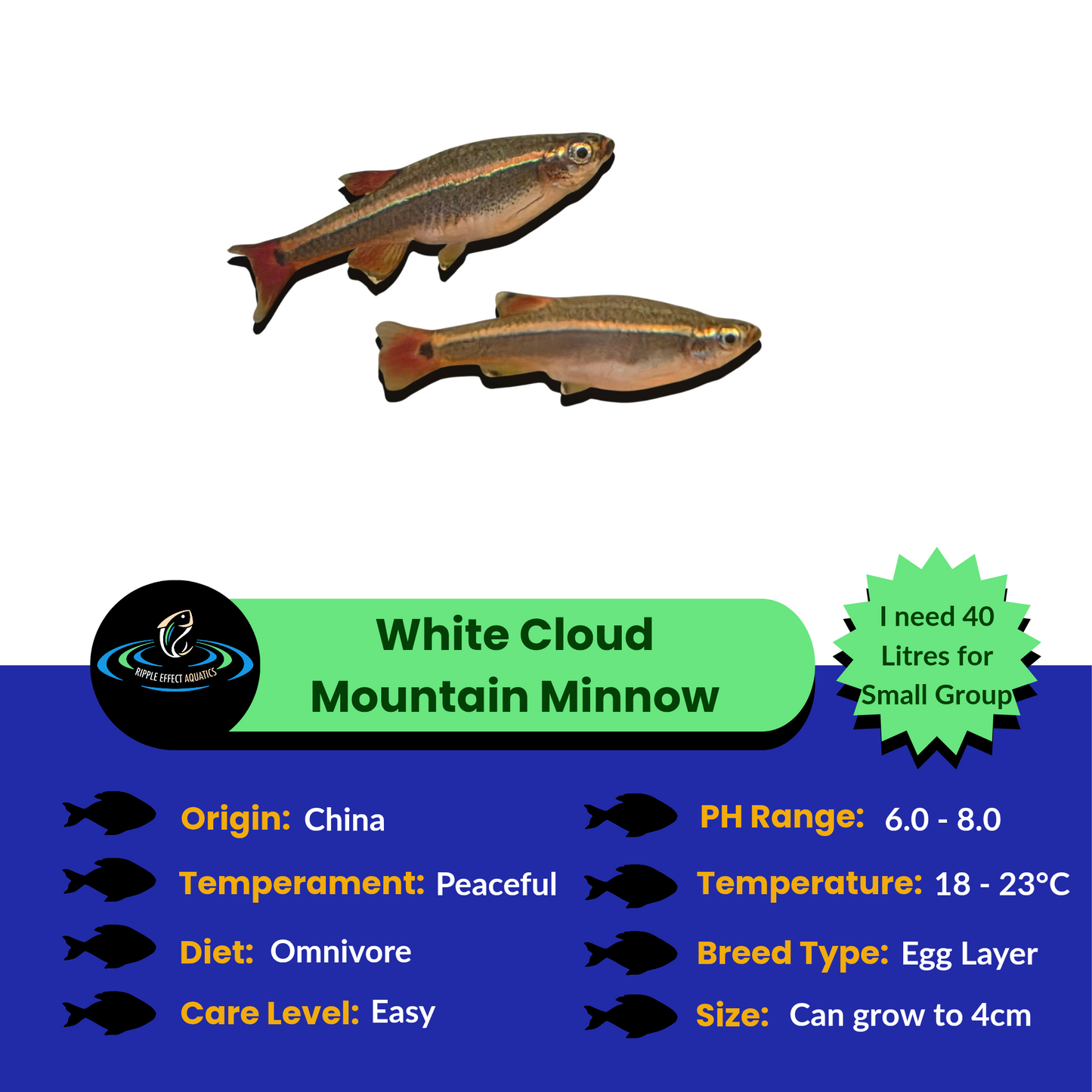
Description:
The White Cloud Mountain Minnow (Tanichthys albonubes) is a small, peaceful freshwater fish native to the cool, fast-flowing streams of White Cloud Mountain in southern China. Prized for their shimmering silver bodies and striking red, gold, black and white highlights, these minnows are a favourite in the aquarium hobby for both their hardiness and beauty. Their graceful shoaling behaviour and colourful appearance make them a delightful addition to planted and community tanks.
Males typically display more vibrant colouration, with brighter red caudal fins and a more streamlined body. Females, while slightly plumper and less intensely coloured, are equally charming and provide balance within a group. When kept in larger schools/shoals, their social interactions and coordinated swimming bring movement and vitality to any aquascape.
White Cloud Mountain Minnows are particularly well suited to unheated aquariums and ponds, thriving in cooler temperatures where many tropical species cannot. Their adaptability, peaceful temperament, and modest care requirements make them an excellent choice for beginners and experienced hobbyists alike.
Temperament:
Known for their gentle and social nature, White Cloud Mountain Minnows do best when kept in schools of six or more. They are ideal community fish, coexisting peacefully with other small, non aggressive species. Their calm disposition and active mid water swimming make them perfect companions for similarly sized fish that prefer cooler water conditions.
Diet:
White Cloud Mountain Minnows are omnivorous and readily accept a variety of foods. In the wild, they feed on small insects, larvae, and plant matter. In the aquarium, they will thrive on a balanced diet of high quality flakes such as Xtreme Community Crave or micro pellets, along with occasional treats of live or frozen foods such as daphnia, brine shrimp, and micro worms. Supplementing their diet with finely chopped vegetables or spirulina-based foods such as Xtreme Spirulina Flakes will enhance their health and colouration.
Breeding Behaviour:
White Cloud Minnows are egg-scatterers with simple yet fascinating breeding behaviour. Mature males become more brightly coloured and may chase each other briefly to court females, while females develop a rounder body when carrying eggs. Spawning usually takes place among fine-leaved plants, moss, or spawning mops, where the female scatters eggs and the male fertilises them as they fall.
Some of the eggs may be eaten by the adults and other fish, so providing materials such as coconut husk, leaf litter, or other substrates on the bottom of the aquarium can help. The eggs fall into and underneath these materials, keeping them out of reach until they hatch, it is best to remove the parents after the breeding period for best chances of fry survival. Once the fry are old enough, they will rise above the husk and begin swimming freely.
After hatching, the tiny fry initially feed on microscopic foods, gradually moving onto baby brine shrimp or finely crushed food such as Xtreme Nice Crumble as they grow. To encourage breeding, provide dense plant cover, maintain clean, slightly cooler water, and feed adults a varied, high-quality diet to keep them in top condition.
Care Guide:
- Species – Tanichthys albonubes
- Common Name – White Cloud Mountain Minnow
- Origin – China
- Temperament - Peaceful
- Diet – Omnivore
- Minimum Tank Requirement - 40 litres for small group
- Tank Level - Top Dwellers
- Care Level - easy
- PH Range – 6.0 – 8.0
- Temperature – Cold & Tropical 15°c – 24°c
- Breed Type – Egg Scatterers
- Size – approximately 4cm
- Sex – Un-sexed
Acclimation Guide:
- Float the Bag: Place the unopened bag in your tank and let it float for 15–20 minutes. This lets the water inside the bag slowly match your tank’s temperature.
- Turn Off the Lights: Keep the aquarium lights off during this process. It helps keep things calm and prevents sudden temperature changes.
- Add a Bit of Tank Water: After floating, carefully open the bag and pour out about half the water into a sink or bucket (not into your tank). Then, slowly add small amounts of your tank water into the bag over 15–20 minutes. This helps your fish adjust to the new water conditions.
- Gently Move the Fish: Use a fish net to gently move your fish from the bag into the tank. Try not to pour the bag water into your tank — this helps keep your aquarium clean and healthy.
- Watch and Wait: It’s normal for fish to hide or act a bit shy at first. Keep an eye on them, and avoid doing a water change for the first 24 hours to give them time to settle in.
- Feeding Behaviour: New fish may not eat any food for the first 12-24 hours whilst it is settling into its new environment, please allow some time before feeding as the food may go to waste.
For more detailed steps and tips, feel free to visit our Acclimation Guide in our Education tab to help make the transition as smooth as possible for your new fish.


White Cloud Mountain Minnow
White Cloud Mountain Minnow
Size Guide


Adult size 4cm
Selected size —
Out of stock
We recommend a minimum school of 6–12 fish to reduce shyness, build confidence, and see their natural, tight shoaling behavior. Discount applies automatically when added to cart.
Everything about shipping, care and guarantees is just below.
Shipping & Live Arrival Guarantee
Shipping & Live Arrival Guarantee
✅ Healthy Fish Guarantee - All orders are covered by our Live Arrival Guarantee with DOA (Dead On Arrival) policies in place for peace of mind.
🚚 $30 flat-rate shipping - Arrives within 1-4 business days, Free shipping on fish for orders over $150.
📦 Ordering supplies too? - Dry goods ship separately and have their own $11.95 shipping fee. This ensures faster delivery, so your fish never wait for equipment to be in stock. When ordering both fish and dry goods, both shipping fees apply ($30 + $11.95 = $41.95 total).
🌿 Packed safely - Fast, reliable shipping with oxygen, insulation and careful handling, packaging Includes insulated boxes, insulation such as news paper to keep everything warm and snug, heat packs during colder seasons, and high quality fish bags.
📦🐟 Live Fish Ship Mondays & Tuesdays Only - To minimise transit time and ensure your fish arrive happy and healthy.
🚚💨Express shipping ONLY - These orders will be defaulted to Express shipping so your fish get to you as fast as possible.
💙 Thank you - for helping us put the health and safety of our fish first!
👉 For more detailed information, please visit our shipping page.
Tank Requirements - Quick Overview
Tank Requirements - Quick Overview
If your aquarium is new, it may not be fully cycled yet. Newly set up tanks benefit from being fully cycled before adding fish, this process helps your new fish stay happy and healthy. Depending on your tank size, cycling can take up to 4–6 weeks or even longer, but there are ways to speed up this process to just a few days! If your tank has already been running for a while, you’re already good to go! Not sure what cycling means? Check out our guide on The Nitrogen Cycle for an easy explanation on what it is, and why it is important for your aquarium to thrive.
🐟 Want expert tips for your aquarium? Beginners can start with How to set up your aquarium, while everyone can check out Aquarium Maintenance & Care for ongoing tank tips!
How We Package & Ship Your Fish - Video
How We Package & Ship Your Fish - Video
Couldn't load pickup availability



Tank Mate Compatibility
✅ Compatible With
- Other White Clouds — Standard and Golden White Cloud Mountain Minnows can be kept together and will school beautifully as a mixed group
- Temperate Schooling Fish — Zebra Danios, Celestial Pearl Danios, and Medaka Ricefish share similar temperature requirements and peaceful temperaments
- Cool-Tolerant Bottom Dwellers — Hillstream Loaches, Kuhli Loaches, and Peppered Corydoras can tolerate the cooler temperatures White Clouds prefer
- Invertebrates — Neocaridina Shrimp (Cherry, Blue Dream), Amano Shrimp, Ramshorn Snails, and Nerite Snails all coexist safely
- African Dwarf Frogs — Generally compatible in cooler community setups
❌ Avoid or Use Caution
- High-Temperature Tropical Fish — Discus, German Blue Rams, and any species requiring temperatures above 24°C are incompatible — White Clouds will struggle in warm water long term
- Large or Aggressive Fish — Large Cichlids, large Barbs, and any predatory fish will view White Clouds as food given their small 4cm size
- Goldfish — While temperature compatible, White Clouds may nip the fins of fancy Goldfish, and larger Goldfish can eat them
- Betta Fish — Bettas require 26–28°C which is too warm for White Clouds to thrive long term, making them fundamentally incompatible despite similar size
Frequently Asked Questions
Do White Cloud Mountain Minnows need a heater?
No — White Clouds are one of the few aquarium fish that thrive without a heater. They prefer cooler temperatures of 15–24°C and are well suited to unheated indoor aquariums and outdoor ponds in temperate climates. Avoid keeping them in warm tropical setups as sustained high temperatures will shorten their lifespan.
How many White Clouds should I keep together?
White Clouds are schooling fish and should be kept in groups of at least 6. Larger schools of 10 or more produce the most impressive shoaling displays and keep individual fish confident and stress-free. A lone or small group of White Clouds will often become shy and spend most of their time hiding.
Are White Cloud Mountain Minnows good for beginners?
Yes, they are one of the best beginner fish available. They are extremely hardy, tolerant of a wide range of water conditions (pH 6.0–8.0), do not require a heater, and are easy to feed. Their peaceful nature and active schooling behaviour make them engaging and low-maintenance for new aquarists.
What do White Cloud Mountain Minnows eat?
White Clouds are omnivores and readily accept most aquarium foods. High-quality flakes such as Xtreme Community Crave or micro pellets make an excellent staple. Supplement with live or frozen foods such as daphnia, brine shrimp, and micro worms for best health and colouration. Spirulina-based foods such as Xtreme Spirulina Flakes are also beneficial.
What level of the tank do White Clouds swim at?
White Clouds are primarily top to mid level swimmers. They are active and visible throughout the water column but tend to congregate near the surface and in open swimming areas. This makes them excellent companions for bottom dwellers like Corydoras or Hillstream Loaches without competing for the same space.
Can White Cloud Mountain Minnows be kept in a pond?
Yes, White Clouds are well suited to outdoor ponds in temperate climates where temperatures stay within their preferred range of 15–24°C. They are one of the few ornamental fish that can overwinter outdoors in mild Australian climates, though they should be brought indoors if temperatures drop below 10°C for extended periods.
Will White Clouds eat their own eggs or fry?
Yes. White Clouds are egg scatterers and will consume their own eggs and fry if given the opportunity. To improve fry survival, provide dense planting, spawning mops, or coconut husk on the substrate, eggs fall into these materials and remain out of reach of adults. Remove parents after spawning for the best survival rates.
Can I keep Golden White Clouds with standard White Clouds?
Yes, Golden White Cloud Mountain Minnows are a colour variant of the same species and are behaviourally identical. They school together naturally and create a beautiful mixed display of silver and gold. Care requirements are exactly the same for both varieties.
What size tank do White Cloud Mountain Minnows need?
A minimum of 40 litres is recommended for a small group of 6. They are active swimmers and appreciate open swimming space, so longer tanks are preferable over tall narrow ones. Larger groups will need proportionally more space, a group of 10–12 will do best in 60 litres or more.
Are White Cloud Mountain Minnows compatible with tropical fish?
Only with species that tolerate the lower end of the tropical range (around 22–24°C). Fish requiring temperatures above 24°C are not suitable long-term companions as the temperature compromise will stress one or both species. Stick to temperate or cool-tolerant species for the best results.
Fish may vary slightly in colour, size, and pattern from those pictured or shown in images and videos. This is natural across all fish, whether bred in-house, locally sourced, or imported, as individual variation is part of what makes each fish unique!
Every fish is quality checked for health, behaviour, and appearance before leaving our fish room. Fish that are dispatched as juveniles will grow into their adult size and colouration over time with a good balanced diet and proper care.
Whether you need filters, fish nets, breeding boxes, or aquascape accessories, you can find all of our premium supplies here.