Breeding In Progress - Coming Soon
Description:
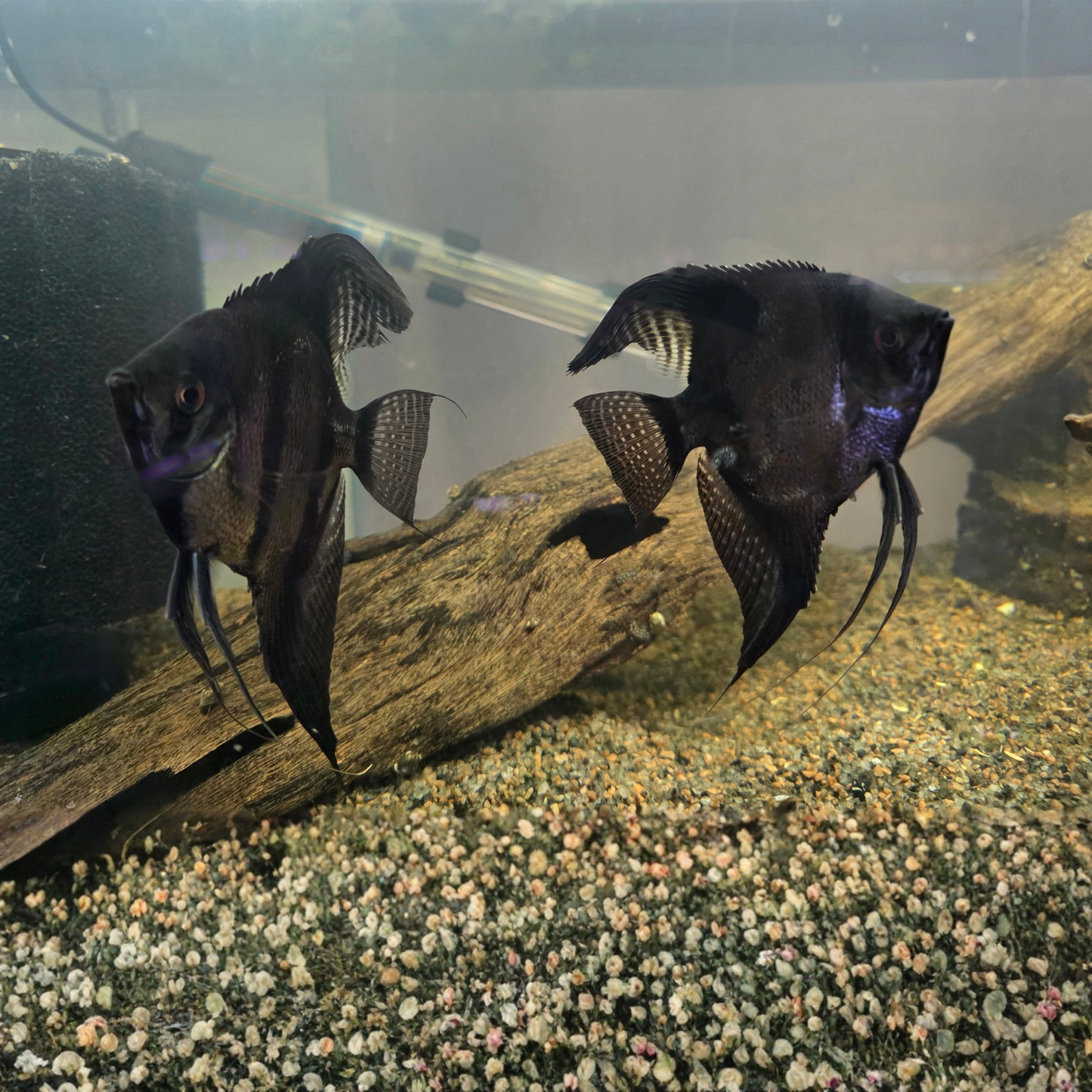
The Black Angelfish is a true classic in the aquarium hobby and stands as one of the most recognisable freshwater fish available. Known scientifically as Pterophyllum scalare. They make for outstanding centrepiece fish in community aquariums and are considered very easy to keep. After extensive captive breeding, many colour variations have been developed, and one of the boldest of these morphs is the Black Angelfish.
These fish display a striking jet-black colouration, often accompanied by a subtle iridescent blue sheen. Some individuals carry a faint patterning across their fins, adding an extra layer of visual depth to an already eye-catching fish. Their laterally compressed, disc-shaped bodies are accentuated by elongated dorsal and anal fins, giving them an elegant, sail-like silhouette that commands attention in virtually any aquarium setting, whether a bright planted tank or a dimly lit biotope setup. As a scalare species, they can grow to a reasonable size while maintaining a very slim profile, almost resembling an arrowhead gliding gracefully through the water.
Distinguishing males from females can be challenging, particularly when the fish are young. As they mature, dominant males will develop a small but noticeable hump on their forehead or by observing their breeding tubes during mating. Certainty of sex is typically only confirmed once a breeding pair has formed. Black Angelfish are not found in the wild as they are a captive-bred colour variation, though the angelfish species as a whole originates from the rivers and floodplains of South America.
Temperament:
The Black Angelfish is a generally peaceful species, with aggression typically only emerging in males during breeding periods. They make excellent community fish and will coexist harmoniously with a wide range of species provided adequate space is given. It is worth noting that angelfish may show aggression towards one another if kept in very small groups and with fish species that look similar to themselves, Angelfish may consume anything that fits in their mouth such as micro fish, some tetras, fry and shrimp.
Angelfish can be kept as a single centerpiece fish, but they do well in mated pairs or larger groups. Sufficient space is critical since they are territorial. Keeping them in larger groups actually helps manage and distribute aggression; housing 5 or 6 angelfish together is much better than keeping just 3.
A sand or gravel substrate works well, and a well-planted aquarium with branching driftwood and rock formations will be greatly appreciated. This species is most active when the aquarium lights are on during the day.
Diet:
Black Angelfish are omnivores by nature, feeding on a combination of plant matter such as algae and small insects and crustaceans in the wild. In the aquarium, they are a very easy species to feed and will readily accept a wide range of foods including quality pellets and flakes. A well-balanced food with good protein and plant-based content is ideal to support their health and maintain their striking colouration.
In our fish room, we feed Xtreme NICE Crumble during the fry stages to support healthy early development. Once they reach a larger size, we complement their diet with Xtreme Community Crave and a quality semi-floating pellet to ensure they receive a well-rounded and nutritious diet as they grow.
Breeding Behaviour:
Black Angelfish are open spawners, depositing their eggs on flat, clean surfaces rather than in caves or enclosed spaces. A bonded pair will meticulously clean a chosen spawning site, which may include broad plant leaves, flat rocks, pieces of slate, tiles, or even the aquarium glass, before the female begins laying her eggs in neat, orderly rows. The male follows closely behind, fertilising each row as she goes.
Both parents actively participate in guarding the eggs, fanning them with their fins to maintain oxygenation and removing any unfertilised or fungused eggs to protect the clutch. This parental dedication is one of the most fascinating behaviours to observe in the aquarium hobby. First-time breeders may consume their eggs a few times due to stress or inexperience, though this behaviour typically diminishes with subsequent spawning attempts.
The eggs generally hatch within 48 to 60 hours depending on water temperature. The parents will often relocate the wriggling larvae to a new surface, continuing to guard them closely. The newly hatched fry feed on their yolk sacs for the first two to three days and then become free-swimming approximately five to seven days after hatching and will begin searching for food. At this stage, offer very fine foods such as freshly hatched baby brine shrimp, microworms, or a quality powdered fry food to support healthy early development, once some size has been gained you can move onto more solid foods such crumble flakes or pellets.
To encourage successful breeding, maintain warm, soft, slightly acidic water with botanicals such as indian almond leaves and provide a calm environment with minimal disturbance.
Condition the pair with a varied diet of live and frozen foods in the weeks leading up to spawning. Separating the breeding pair into a dedicated tank greatly improves the chances of raising fry through to maturity.
Care Guide:
- Species – Pterophyllum scalare
- Common Name – Black Angelfish
- Origin – South America
- Temperament – Peaceful - Can Be Semi Aggressive
- Diet – Omnivore
- Minimum Tank Requirement – 75 litres - Tall tanks
- Tank Level – Middle Dweller
- Care Level – Easy
- PH Range – 5.0 – 7.0
- Temperature – Tropical 24°c – 26°c
- Breed Type – Open Spawner
- Size – 12–15cm length, up to 20cm tall
- Sex – Un-sexed
Acclimation Guide:
- Float the Bag: Place the unopened bag in your tank and let it float for 15–20 minutes. This lets the water inside the bag slowly match your tank’s temperature.
- Turn Off the Lights: Keep the aquarium lights off during this process. It helps keep things calm and prevents sudden temperature changes.
- Add a Bit of Tank Water: After floating, carefully open the bag and pour out about half the water into a sink or bucket (not into your tank). Then, slowly add small amounts of your tank water into the bag over 15–20 minutes. This helps your fish adjust to the new water conditions.
- Gently Move the Fish: Use a fish net to gently move your fish from the bag into the tank. Try not to pour the bag water into your tank — this helps keep your aquarium clean and healthy.
- Watch and Wait: It’s normal for fish to hide or act a bit shy at first. Keep an eye on them, and avoid doing a water change for the first 24 hours to give them time to settle in.
- Feeding Behaviour: New fish may not eat any food for the first 12-24 hours whilst it is settling into its new environment, please allow some time before feeding as the food may go to waste.
For more detailed steps and tips, feel free to visit our Acclimation Guide in our Education tab to help make the transition as smooth as possible for your new fish.

Black Angelfish
Black Angelfish
Size Guide


Adult size 15cm
Selected size —
Out of stock
If buying more than 1 we recommend a group of 5 or more to distribute natural aggression evenly and allow breeding pairs to form as they mature. Discount applies automatically when added to cart.
Everything about shipping, care and guarantees is just below.
Shipping & Live Arrival Guarantee
Shipping & Live Arrival Guarantee
✅ Healthy Fish Guarantee - All orders are covered by our Live Arrival Guarantee with DOA (Dead On Arrival) policies in place for peace of mind.
🚚 $30 flat-rate shipping - Arrives within 1-4 business days, Free shipping on fish for orders over $150.
📦 Ordering supplies too? - Dry goods ship separately and have their own $11.95 shipping fee. This ensures faster delivery, so your fish never wait for equipment to be in stock. When ordering both fish and dry goods, both shipping fees apply ($30 + $11.95 = $41.95 total).
🌿 Packed safely - Fast, reliable shipping with oxygen, insulation and careful handling, packaging Includes insulated boxes, insulation such as news paper to keep everything warm and snug, heat packs during colder seasons, and high quality fish bags.
📦🐟 Live Fish Ship Mondays & Tuesdays Only - To minimise transit time and ensure your fish arrive happy and healthy.
🚚💨Express shipping ONLY - These orders will be defaulted to Express shipping so your fish get to you as fast as possible.
💙 Thank you - for helping us put the health and safety of our fish first!
👉 For more detailed information, please visit our shipping page.
Tank Requirements - Quick Overview
Tank Requirements - Quick Overview
If your aquarium is new, it may not be fully cycled yet. Newly set up tanks benefit from being fully cycled before adding fish, this process helps your new fish stay happy and healthy. Depending on your tank size, cycling can take up to 4–6 weeks or even longer, but there are ways to speed up this process to just a few days! If your tank has already been running for a while, you’re already good to go! Not sure what cycling means? Check out our guide on The Nitrogen Cycle for an easy explanation on what it is, and why it is important for your aquarium to thrive.
🐟 Want expert tips for your aquarium? Beginners can start with How to set up your aquarium, while everyone can check out Aquarium Maintenance & Care for ongoing tank tips!
How We Package & Ship Your Fish - Video
How We Package & Ship Your Fish - Video
Couldn't load pickup availability



Tank Mate Compatibility
✅ Compatible With
- Other Angelfish — Can be kept with other angelfish varieties provided adequate space is given to reduce territorial disputes
- Tetras & Gouramis — Peaceful mid-water species that coexist well without competing for territory
- Corydoras & Bristlenose — Bottom dwellers that generally get along well with angelfish in a community setup
- Dwarf Cichlids — Species such as rams that share similar water parameters and temperament
- Large Peaceful Cichlids — Species such as Uaru or Severums that are non-aggressive and similarly sized
❌ Avoid or Use Caution
- Very Small Fish & Fry — Tiny species such as neon tetras and small shrimp may be viewed as prey by adult angelfish
- Fin Nippers — Species known to nip fins will target the angelfish's long, flowing fins and cause stress or injury
- Semi-Aggressive Cichlids — Species such as firemouths and convict cichlids can be kept with caution but may cause conflict
- Large Aggressive Species — African cichlids, Oscars, and Jaguar cichlids should be avoided as they will bully or harm angelfish
- Similar-Looking Fish — Angelfish may display aggression toward species with a similar body shape or appearance
Frequently Asked Questions
Are Black Angelfish good for beginners?
Yes, Black Angelfish are considered an easy species to keep and are a fantastic choice for aquarists of all experience levels. They are hardy, adaptable, and readily accept a wide range of aquarium foods, making them one of the more forgiving cichlid species available. Their striking appearance and peaceful temperament also make them an excellent centrepiece fish for community aquariums.
How big do Black Angelfish get?
Black Angelfish reach approximately 12 to 15 cm in length and can grow up to 20 cm tall including their elongated dorsal and anal fins. Their slim, laterally compressed profile means they take up less horizontal space than their height suggests, but a tank with good vertical height is recommended to allow them to display their full finnage comfortably.
What size tank do Black Angelfish need?
A minimum of 75 litres is recommended for Black Angelfish. Because they can be territorial at times, a tank with a good footprint gives them room to establish space without conflict. A well-planted aquarium with branching driftwood, rock formations, and open swimming areas provides the ideal environment for them to thrive.
Can Black Angelfish be kept in a community tank?
Yes, Black Angelfish are well suited to community aquariums. They are peaceful by nature and coexist well with a wide range of species including tetras, gouramis, corydoras, Bristlenose, and dwarf cichlids such as rams. Avoid housing them with very small fish or shrimp that may be viewed as prey, fin-nipping species such as some barbs, or large aggressive fish such as Oscars and African cichlids.
How many Black Angelfish should I keep together?
Black Angelfish can be kept individually, in mated pairs, or in groups. If keeping a group, ensure the tank has sufficient space as they can be territorial, particularly during breeding periods. A mated pair is often the most straightforward approach and allows you to observe their fascinating breeding and parental behaviour.
What do Black Angelfish eat?
Black Angelfish are omnivores and will readily accept a wide range of aquarium foods including quality pellets, frozen or live foods and and flakes. In our fish room, we feed Xtreme NICE Crumble during the fry stages to support healthy early development. Once they reach a larger size, we complement their diet with Xtreme Community Crave, frozen foods and a quality semi-floating pellet to ensure a well-rounded and nutritious diet as they grow.
What water parameters do Black Angelfish need?
Black Angelfish prefer warm, soft, slightly acidic water with a temperature between 24°C and 26°C and a pH range of 5.0 to 7.0. Maintaining stable water chemistry within these parameters is important for their long-term health, colouration, and breeding success. Regular water changes and a reliable heater are recommended to keep conditions consistent.
Will Black Angelfish breed in my aquarium?
Yes, Black Angelfish will breed readily once a compatible pair has formed and conditions are suitable. They are open spawners, meaning they deposit their eggs on flat surfaces such as broad plant leaves, slate, or the aquarium glass rather than in caves. Both parents guard the eggs and care for the fry, making them one of the more rewarding cichlids to breed in a home aquarium.
How do I tell male and female Black Angelfish apart?
Sexing Black Angelfish can be difficult, particularly when they are young. As they mature, dominant males may develop a small but noticeable hump on their forehead. The most reliable way to determine sex is when a breeding pair forms naturally, at which point the female's broader, rounded breeding tube becomes visible compared to the male's narrower breeding tube.
Are Black Angelfish found in the wild?
Black Angelfish are not found in the wild. They are a captive-bred colour morph developed through selective breeding of Pterophyllum scalare, the common angelfish, which originates from the rivers and floodplains of South America. The deep, uniform black colouration is a result of generations of selective breeding and is maintained through quality care and diet in the aquarium.
Fish may vary slightly in colour, size, and pattern from those pictured or shown in images and videos. This is natural across all fish, whether bred in-house, locally sourced, or imported, as individual variation is part of what makes each fish unique!
Every fish is quality checked for health, behaviour, and appearance before leaving our fish room. Fish that are dispatched as juveniles will grow into their adult size and colouration over time with a good balanced diet and proper care.
Whether you need filters, fish nets, breeding boxes, or aquascape accessories, you can find all of our premium supplies here.