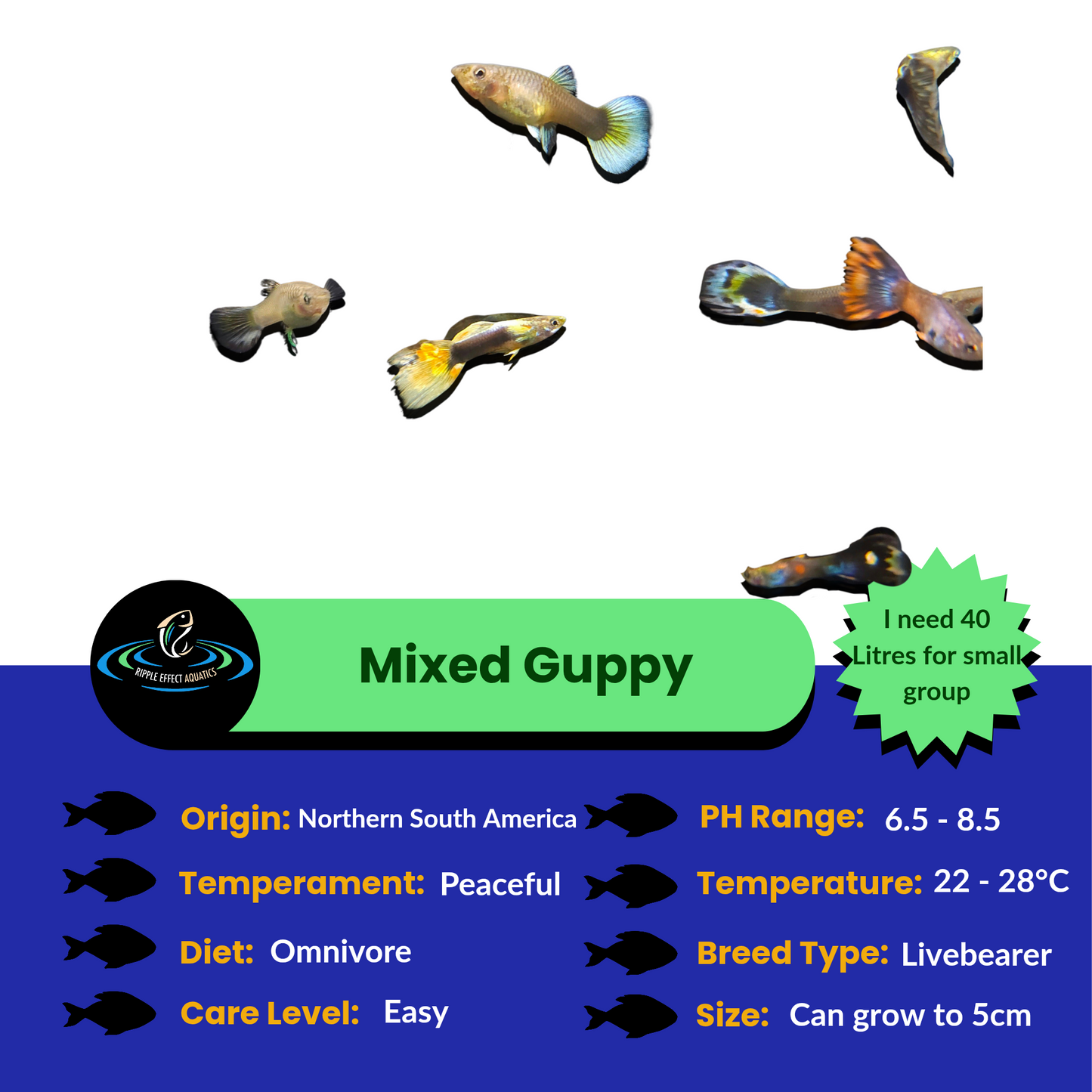
Description:
Guppies (Poecilia reticulata) are renowned for their vibrant colours and intricate patterns. Males typically display vivid hues such as red, blue, green, orange, and yellow, often arranged in striking patterns like stripes, spots, or speckles. Their iridescent sheen adds to their visual appeal as they swim gracefully through the water. Females, in contrast, are generally larger and exhibit more subdued, monochromatic tones.
Guppies are hardy and adaptable fish that thrive under typical freshwater tropical aquarium conditions. They do especially well in planted tanks, where dense foliage provides shelter and helps reduce stress. They prefer stable, warm water and will generally show their best colouration and activity when kept in consistent conditions. Their small size makes them suitable for smaller aquariums, though they always appreciate extra swimming space and cover. Due to their size, it’s best to avoid housing guppies with larger predatory fish. They thrive best when kept with similarly sized, peaceful community fish.
Temperament:
Known for their peaceful demeanour, guppies coexist harmoniously with other gentle fish in community setups. They are highly active and curious, constantly exploring their surroundings, grazing biofilm, and interacting with one another. Males may occasionally display or chase during social and breeding behaviour, but serious aggression is rare. They use all areas of the aquarium and will often gather near the surface around feeding time. Guppies breed readily without special preparation as long as both sexes are present. Females give birth to live fry roughly every 23–30 days and can store sperm for later fertilisation, leading to ongoing reproduction even without males present.
Diet:
Guppies are omnivorous, readily accepting a wide range of commercially available foods. Due to their small mouths, flake foods are best crushed before feeding. High-quality options such as Xtreme Community Crave Flakes or Xtreme Nice Crumble make excellent staples, providing balanced nutrition in a size suitable for both adults and growing fish. A varied diet including vegetable matter and occasional live or frozen foods will further support optimal health and colouration.
Breeding Behaviour:
Livebearers, such as guppies, are some of the easiest fish to breed in the aquarium hobby. Unlike egg-laying species, livebearers give birth to fully-formed, free-swimming fry, making the process simple but also potentially overwhelming due to how quickly populations can grow.
Males constantly court females by displaying their colourful fins and using their gonopodium (a modified anal fin) to transfer sperm. Females can store sperm internally for several months, meaning a single successful mating can result in multiple batches of fry without needing a male present for every pregnancy.
Once pregnant, the female will begin to develop a gravid spot, a dark area near her anal fin, and her belly will grow much rounder. Gestation usually lasts around 4 weeks, depending on temperature and conditions. Just before giving birth, the female may isolate herself in a quiet area of the tank or behave restlessly.
When she gives birth, the fry are immediately free-swimming and capable of feeding on tiny foods such as powdered fry food, crushed flakes, or baby brine shrimp. However, adult fish (including the parents) will often eat the newborn fry if given the chance. To improve survival rates, provide dense plants like java moss, hornwort, guppy grass, or fast-growing floating plants for hiding, or move the pregnant female to a separate breeding tank shortly before she gives birth.
Females can give birth to anywhere from a handful of fry to 50 or more in a single batch, depending on their size, age, and health, and in some occasions these numbers can reach 100. After giving birth, she can be returned to the main tank, while the fry remain in their own tank or nursery area until they are large enough to avoid being eaten.
Care Guide:
- Species – Poecilia reticulata
- Common Name – Guppy
- Origin – North coast of South America
- Temperament – Peaceful
- Diet – Omnivore
- Minimum Tank Requirement – 40 litres for small group
- Tank Level – Preferred top dweller – every level
- Care Level – Easy
- PH Range – 6.5 – 8.5
- Temperature – Tropical 22–28°C
- Breed Type – Livebearer – reproduce rapidly
- Size – Grows to approximately 2.5–5cm
- Sex – Un-sexed
Acclimation Guide:
- Float the Bag: Place the unopened bag in your tank and let it float for 15–20 minutes. This lets the water inside the bag slowly match your tank’s temperature.
- Turn Off the Lights: Keep the aquarium lights off during this process. It helps keep things calm and prevents sudden temperature changes.
- Add a Bit of Tank Water: After floating, carefully open the bag and pour out about half the water into a sink or bucket (not into your tank). Then, slowly add small amounts of your tank water into the bag over 15–20 minutes. This helps your fish adjust to the new water conditions.
- Gently Move the Fish: Use a fish net to gently move your fish from the bag into the tank. Try not to pour the bag water into your tank — this helps keep your aquarium clean and healthy.
- Watch and Wait: It’s normal for fish to hide or act a bit shy at first. Keep an eye on them, and avoid doing a water change for the first 24 hours to give them time to settle in.
- Feeding Behaviour: New fish may not eat any food for the first 12-24 hours whilst it is settling into its new environment, please allow some time before feeding as the food may go to waste.
For more detailed steps and tips, feel free to visit our Acclimation Guide in our Education tab to help make the transition as smooth as possible for your new fish.


Mixed Guppy - Assorted
Mixed Guppy - Assorted
Size Guide


Adult size 5cm
Selected size —
Low stock: 20 left
We recommend a group of 5 or more to see their active, social behaviour. To ensure a peaceful tank, aim for a ratio of 1 male to every 2-3 females or single sex tanks. Discount applies automatically when added to cart.
Our livebearers are raised in mixed-sex tanks to promote natural breeding, so some females can arrive already pregnant, even if it isn’t showing at the time. This is normal and a sign of a thriving, well-maintained colony!
These Guppies are sold as unsexed, if you are wanting male and female please reach out to us and we can help you out the best we can, we dont always have both genders avaliable.
Everything about shipping, care and guarantees is just below.
Shipping & Live Arrival Guarantee
Shipping & Live Arrival Guarantee
✅ Healthy Fish Guarantee - All orders are covered by our Live Arrival Guarantee with DOA (Dead On Arrival) policies in place for peace of mind.
🚚 $30 flat-rate shipping - Arrives within 1-4 business days, Free shipping on fish for orders over $150.
📦 Ordering supplies too? - Dry goods ship separately and have their own $11.95 shipping fee. This ensures faster delivery, so your fish never wait for equipment to be in stock. When ordering both fish and dry goods, both shipping fees apply ($30 + $11.95 = $41.95 total).
🌿 Packed safely - Fast, reliable shipping with oxygen, insulation and careful handling, packaging Includes insulated boxes, insulation such as news paper to keep everything warm and snug, heat packs during colder seasons, and high quality fish bags.
📦🐟 Live Fish Ship Mondays & Tuesdays Only - To minimise transit time and ensure your fish arrive happy and healthy.
🚚💨Express shipping ONLY - These orders will be defaulted to Express shipping so your fish get to you as fast as possible.
💙 Thank you - for helping us put the health and safety of our fish first!
👉 For more detailed information, please visit our shipping page.
Tank Requirements - Quick Overview
Tank Requirements - Quick Overview
If your aquarium is new, it may not be fully cycled yet. Newly set up tanks benefit from being fully cycled before adding fish, this process helps your new fish stay happy and healthy. Depending on your tank size, cycling can take up to 4–6 weeks or even longer, but there are ways to speed up this process to just a few days! If your tank has already been running for a while, you’re already good to go! Not sure what cycling means? Check out our guide on The Nitrogen Cycle for an easy explanation on what it is, and why it is important for your aquarium to thrive.
🐟 Want expert tips for your aquarium? Beginners can start with How to set up your aquarium, while everyone can check out Aquarium Maintenance & Care for ongoing tank tips!
How We Package & Ship Your Fish - Video
How We Package & Ship Your Fish - Video
Couldn't load pickup availability



Tank Mate Compatibility
✅ Compatible With
- Other Livebearers — Mollies and Platies share similar water parameters, care needs, and peaceful temperaments
- Tetras — Smaller calm species such as Neon, Cardinal, Ember, and Glowlight Tetras
- Rasboras — Harlequin Rasboras are a popular and reliable choice
- Danios — Zebra and Pearl Danios are active and peaceful companions
- Gouramis — Honey or Dwarf Gouramis are generally peaceful, best in larger tanks
- Bottom Dwellers — Corydoras (Panda, Bronze, Pygmy) and Kuhli Loaches occupy lower levels with minimal interaction
- Invertebrates — Neocaridina Shrimp (Cherry, Blue Dream), Amano Shrimp, Nerite Snails, and Mystery Snails all coexist well. Provide hiding spots for shrimp
❌ Avoid or Use Caution
- Large Predators — Oscars, Jack Dempseys, and large Cichlids will predate on Guppies
- Aggressive Fin Nippers — Tiger Barbs, Serpae Tetras, and Silver Tip Tetras will target the long flowing tails of male Guppies
- Betta Fish (Males) — Male Bettas are highly territorial and will often attack male Guppies, mistaking their colourful tails for rivals. Some female Bettas may coexist with caution
- Goldfish — Require cooler water and can eventually grow large enough to swallow Guppies
- African Dwarf Frogs — Slow eaters that get outcompeted for food and may nip at long fins
Frequently Asked Questions
Are Guppies good for beginners?
Yes, Guppies are one of the best beginner fish in the hobby. They are hardy, adaptable, peaceful, and easy to feed. Their tolerance for a wide range of water conditions and their forgiving nature make them an excellent first fish for new aquarists.
How many Guppies should I keep and what ratio of males to females?
A small group of 6 or more works well in a 40 litre tank. If keeping males and females together, a ratio of 1 male to 2 females is a great starting point and is how we sell them in trios. For those wanting to reduce male harassment further, 1 male to 3 females is even safer. Providing plenty of plants and hiding spots also helps females get a break from persistent males.
What do Guppies eat?
Guppies are omnivores and accept a wide range of foods. A high-quality crushed flake or micro pellet such as Xtreme Community Crave or Xtreme Nice Crumble makes an excellent staple. Supplement with live or frozen foods such as baby brine shrimp and daphnia to enhance colouration and overall health. Due to their small mouths, always crush flake food before feeding.
What level of the tank do Guppies swim at?
Guppies are primarily top to mid level swimmers but will explore all levels of the aquarium. They are particularly active near the surface and in open swimming areas, though they may venture lower in tanks with larger bottom dwelling fish.
Do Guppies breed easily?
Yes — Guppies are livebearers and one of the easiest fish to breed in the hobby. Females give birth to fully formed, free-swimming fry approximately every 23–30 days. Females can also store sperm internally for several months, meaning continuous reproduction can occur even without a male present. Population growth can happen quickly, so plan accordingly.
Will Guppies eat their own fry?
Yes. Adult Guppies, including the parents, will readily eat newborn fry if given the opportunity. To improve survival rates, provide dense planting such as Java Moss, Hornwort, or floating plants for fry to hide in. Alternatively, move the pregnant female to a separate breeding tank before she gives birth and return her once the fry are free-swimming.
How do I know if my female Guppy is pregnant?
A pregnant female will develop a dark gravid spot near her anal fin and her belly will become noticeably rounder as the pregnancy progresses. Gestation typically lasts around 4 weeks depending on temperature. Just before giving birth she may isolate herself or appear restless.
Can Guppies be kept with other fish?
Yes, Guppies are peaceful community fish that coexist well with most similarly sized, non-aggressive species. Avoid keeping them with fin nippers or large predatory fish. See our compatibility guide above for a full breakdown of suitable and unsuitable tank mates.
Do Guppies need a heater?
Yes. Guppies are tropical fish that thrive at 22–28°C. A reliable heater and thermometer are essential to maintain a stable temperature. Sudden fluctuations can stress fish and make them susceptible to disease, so consistency is key.
Why are my male Guppies constantly chasing females?
This is completely normal breeding behaviour. Males will persistently court females using fin displays and their gonopodium. However, excessive chasing can stress females. Maintaining a ratio of 1 male to 2–3 females and providing plenty of plants and hiding spots will give females a break and reduce stress significantly.
Fish may vary slightly in colour, size, and pattern from those pictured or shown in images and videos. This is natural across all fish, whether bred in-house, locally sourced, or imported, as individual variation is part of what makes each fish unique!
Every fish is quality checked for health, behaviour, and appearance before leaving our fish room. Fish that are dispatched as juveniles will grow into their adult size and colouration over time with a good balanced diet and proper care.
Whether you need filters, fish nets, breeding boxes, or aquascape accessories, you can find all of our premium supplies here.